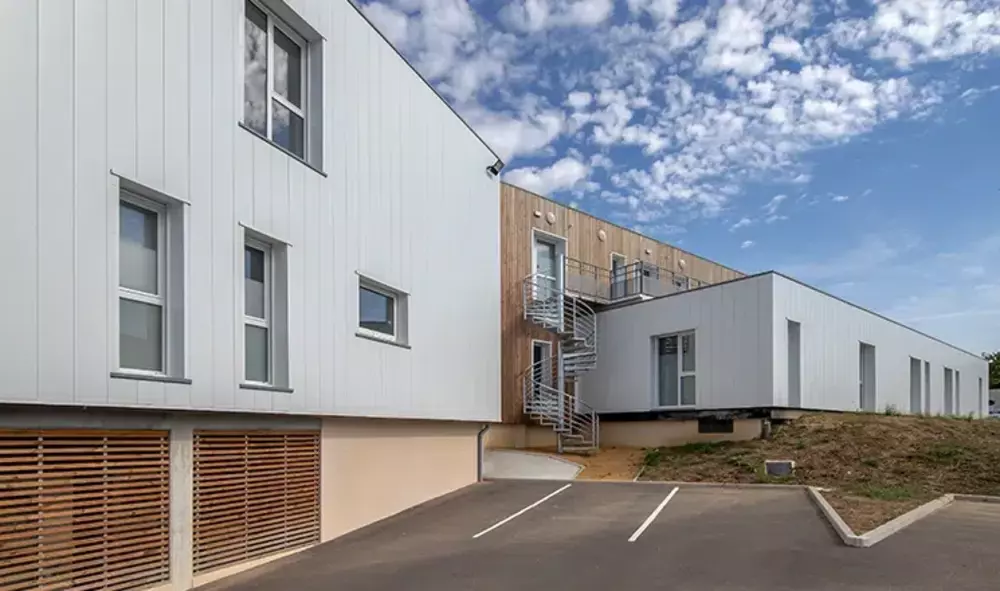
When a laboratory analysis alone is not enough to explain a disorder on a wood cladding
It all begins with a wood-clad façade, recent and apparently in good condition. Then, gradually, translucent orange stains appear. They slightly run down the surface, concentrate at the lower parts of the façades, and resist conventional cleaning methods.
The project owner starts to question the situation. The manufacturer is contacted. Doubt sets in: is this normal, acceptable, or the sign of a deeper disorder ?
To obtain a quick answer, an initial decision is made: to analyze a sample of the deposit. A sample is taken and sent to the laboratory.
The report comes back with a clear result : FTIR spectroscopy analysis identifies an organic compound, compatible with salts of carbohydrate acids.
On paper, the information is precise. But on site, it solves nothing.
The questions remain unanswered.
- Does this compound come from the wood cladding? From the environment? From external pollution?
- Is it responsible for the disorder, or is it simply visible because something else is occurring?
- Can remedial work, warranties or liabilities be engaged on this basis alone?
This is when OSE Services is commissioned. The approach immediately changes.
Before any further analysis, an on-site investigation is carried out. The façades are observed one by one. Affected areas are compared with intact zones. Orientations, water runoff effects, and the presence – or absence – of deposits on metal elements are analyzed.
One detail then becomes decisive: the deposits appear only where water flows, and never on protected surfaces.
- Targeted sampling is carried out at different locations, combined with solubility tests, followed by cross-analyses (FTIR, SEM-EDX). The results are compared with each other, but also confronted with the material characteristics and the available technical data.
Gradually, the full picture emerges.
- The deposit is no longer just a substance identified in the laboratory: it becomes the consequence of a mechanism, linked to the material, water, and real exposure conditions.
This case study illustrates a simple but essential reality:
👉 an isolated analysis describes a sample; an expert assessment tells the complete story of the disorder.
To learn more, read our dedicated article on contextualized analysis.