Laboratory Analysis or Full Expertise?
Why a simple analysis is not enough to understand the origin of a disorder ?
When a deposit appears on a façade, when a wood coating deteriorates, or when a paint or varnish shows anomalies, the first reaction is often to request a laboratory analysis. This approach is legitimate: identifying the chemical nature of an unknown substance is an essential first step.
However, in many situations – building defects, disputes, complex material pathologies, chemical risks – this analysis alone does not make it possible to determine the root cause of the problem, nor to clearly identify responsibilities.
This is precisely where the fundamental difference lies between a raw analytical report and a comprehensive expert assessment carried out by OSE Services.
1. The “raw” analytical report: a chemical snapshot without context
A simple analytical report without interpretation generally relies on one or more targeted analytical techniques, such as FTIR spectroscopy, sometimes supplemented by XRF or other methods.
The sample is analyzed as received, and the laboratory compares the obtained signal with reference libraries.
👉 The result answers a specific question :
“What is this sample made of ?”
This type of report is perfectly suited to simple situations, such as:
- quality control during production,
- compliance verification of a known material,
- comparison between two batches,
- rapid validation of a formulation.
However, a raw analytical report does not answer much more complex questions, which are nevertheless central in the event of a disorder:
- Where does the observed deposit come from?
- Is it related to the material itself, the environment, or external pollution?
- Why does it appear in certain areas and not others?
- Is it compatible with the product’s technical data sheets?
- Is the phenomenon reproducible or accidental?
Without on-site investigation, without understanding the building, climatic and construction context, and without interpretation, the analysis remains isolated information.
It describes a composition, but it does not explain a disorder.
2. The OSE Services approach for complex cases: bringing analysis back to reality
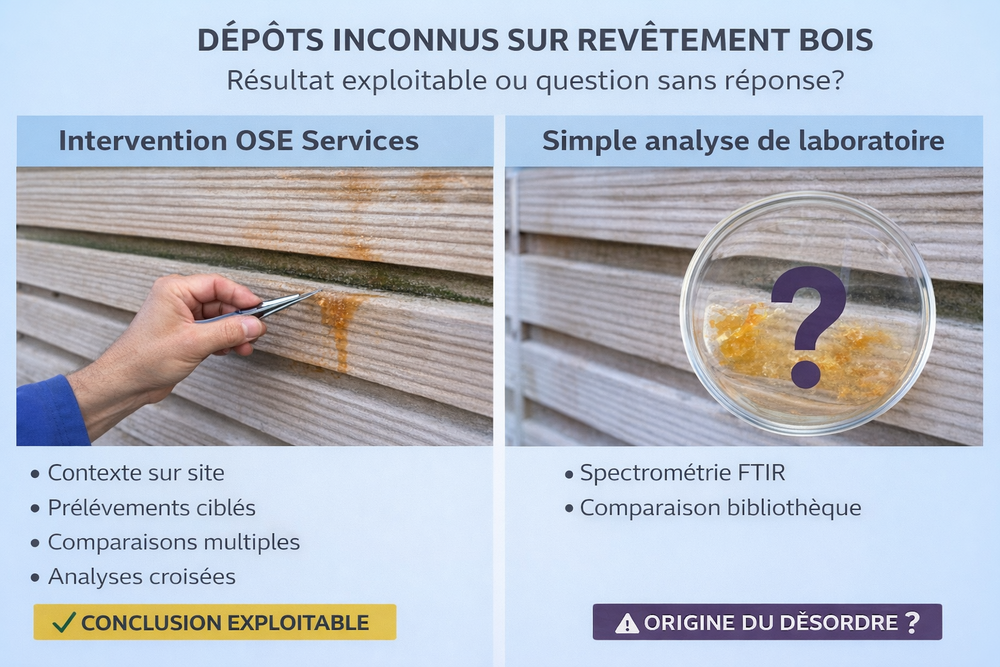
At OSE Services, laboratory analysis is never an end in itself. It is part of a global expert approach, which begins well upstream with an on-site intervention.
This step is decisive. It makes it possible to:
- observe the precise locations of the disorders,
- compare affected and unaffected areas,
- analyze façade orientation, exposure to rain, runoff and sunlight,
- identify interfaces (wood, paint, varnish, coating, metal),
- place the problem back into its real environment.
These observations already make it possible to rule out certain hypotheses even before laboratory testing.
A deposit present only on vertical surfaces, absent from protected areas, or localized at the lower parts of a structure will not have the same origin as a uniform phenomenon.
👉 Without this step, even the most advanced chemical analysis remains disconnected from real-world conditions.
3. Tests, comparisons and cross-analyses
Another major difference between a standard analytical report and an OSE Services expert report lies in the structured multiplication of investigations.
Beyond FTIR spectroscopy, OSE Services may use, depending on the case:
- SEM-EDX to characterize morphology and elemental composition,
- XRF for mineral elements,
- GC-MS, LC-MS, Py-GC/MS for complex organic compounds,
- Isotopic analyses, Carbon-14 for traceability or material origin,
- solubility, migration and extractability tests.
Above all, the results are compared :
- between several samples taken on site,
- between deposits and sound material,
- between analytical results and manufacturers’ technical data sheets,
- between laboratory data and real conditions of use.
This comparative approach is essential to answer the key question:
“Is what we observe compatible with the material itself, or with an external cause?”
It is this logic that ultimately makes it possible to determine the origin of a disorder, and not merely its chemical nature
4. Why this approach has real value in disputes and legal expertise
In the context of disputes, legal expertise, or interventions for building experts, the difference between a raw analysis and an OSE Services expertise is decisive.
A simple analytical report:
- does not establish a causal link,
- does not prioritize hypotheses,
- is generally insufficient to support a technical or legal argument.
Conversely, a comprehensive OSE Services expertise:
- is based on objective on-site observations,
- demonstrates consistency between observations and analyses,
- places results within their technical and environmental context,
- produces reasoning that is understandable to non-chemists,
- leads to conclusions that can be used for decision-making.
This added value precisely justifies a higher level of investment.
Yes, a simple analysis costs less.
But when dealing with unknown products, defects on wood coatings, paints or varnishes, chemical risks or liability issues, analysis alone can lead to premature or even erroneous conclusions.
Conclusion
A laboratory analysis is a tool.
An OSE Services expertise is a comprehensive approach.
For simple quality control cases, a raw analysis may be sufficient.
To understand the origin of a disorder, resolve a dispute or secure a technical decision, you need:
- context,
- comparisons,
- cross-analyses,
- and expert interpretation.
It is this global approach that makes the difference and enables OSE Services to provide a clear, reasoned and actionable answer, where an isolated analysis cannot reach a conclusion.
Do you want to secure your laboratory studies in the context of non-compliance, customer claims, amicable disputes or legal litigation?
Contact us for expert services and technical advice.