OSE Services at SFIIC 2026: Non-invasive in-situ analyses for the conservation and study of contemporary art.
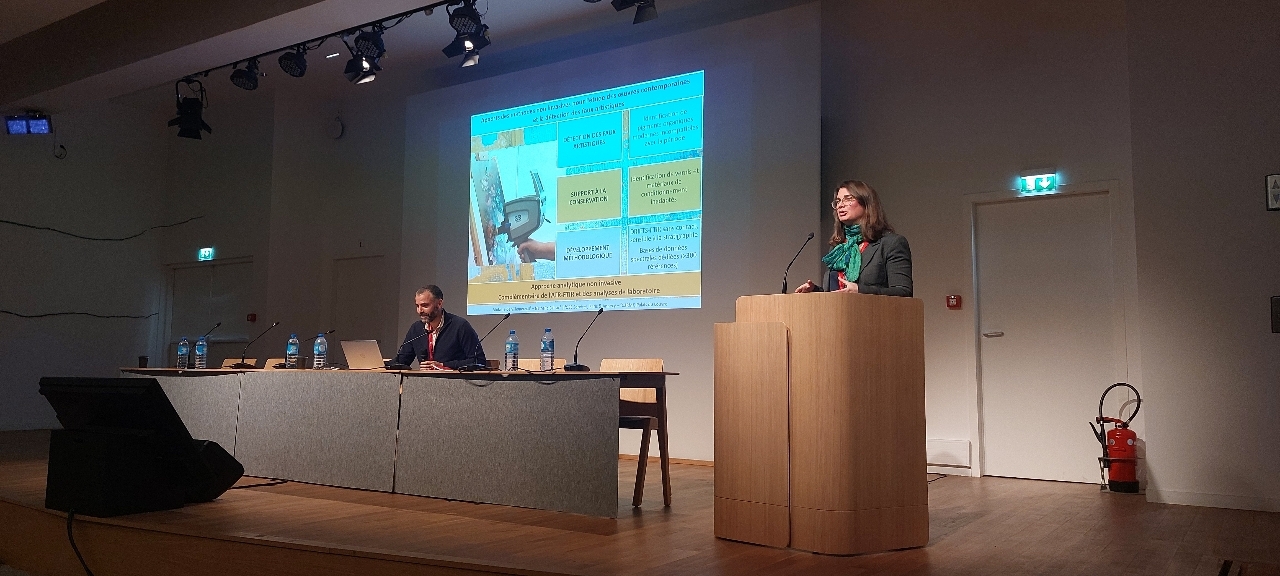
Taking part in an international event such as the SFIIC International Congress 2026 is always a highlight for OSE Services. More than just a scientific gathering, the SFIIC provides a unique forum for dialogue between conservators, curators, researchers, physicists and chemists, all united by a common goal: to advance non-invasive approaches to the study, conservation and understanding of cultural heritage.
The 2026 edition, held in Paris on 29 and 30 January, highlighted in situ non-invasive analytical methods, the scientific documentation of artworks and the synergy between fieldwork and laboratory work. A theme that is fully in line with the DNA of OSE Services.
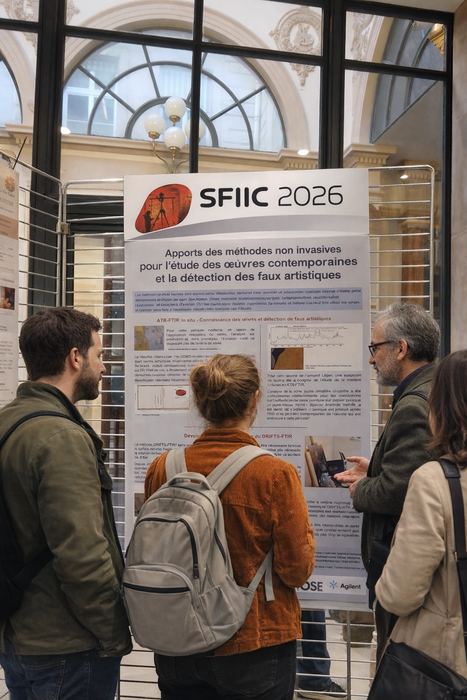
A poster selected to reflect current issues.
We are particularly proud to see our poster selected for this year’s SFIIC. It builds on the work carried out in recent years on on-site material analysis, applied to contemporary artworks and modern materials.
The poster highlights the contribution of portable FTIR infrared spectroscopy, and more specifically the DRIFTS-FTIR (Diffuse Reflectance Infrared Fourier Transform Spectroscopy) technique, in contexts where sampling is limited or even impossible.
Contemporary artworks, due to the diversity of their materials – synthetic pigments, polymers, foams, resins, industrial varnishes – pose specific challenges in terms of conservation, restoration and, at times, authentication. Non-invasive in situ analyses thus become a key tool for documenting the material, guiding conservation decisions and strengthening scientific interpretation.
DRIFTS-FTIR: non-contact analysis, directly on the artwork
Unlike ATR-FTIR, which requires direct contact with the surface being analysed, DRIFTS-FTIR enables non-contact analysis, making it particularly suitable for fragile, sensitive or deteriorated surfaces. This technique also offers sensitivity to stratigraphy, making it invaluable for the study of complex surface layers.
As part of the work presented at SFIIC, DRIFTS-FTIR was used in conjunction with other analytical techniques, such as:
• ATR-FTIR, where contact is possible
• XRF, for elemental characterisation
• Py-GC/MS, for the detailed identification of polymers, binders and varnishes in the laboratory
This cross-disciplinary approach illustrates the importance of the field/laboratory partnership, which lies at the heart of forensic science practices applied to art.
Case study: Lyon Museum of Contemporary Art
Among the examples presented in the poster, a study conducted in collaboration with the Lyon Museum of Contemporary Art provides a concrete illustration of the value of these methods.
During the examination of a contemporary artwork exhibiting localised alterations, in situ DRIFTS-FTIR analyses identified the presence of polyurethane foam used as a cushioning or packaging material. This material, unsuitable for prolonged contact with the artwork, was the cause of visible damage.
In another case, the identification of a synthetic pigment provided essential insights into the artwork, its material history and previous interventions. These results, when compared with Py-GC/MS analyses carried out in the laboratory, confirmed the nature of the materials and validated the interpretation.
These examples demonstrate how the analysis of contemporary materials requires a nuanced approach, at the intersection of analytical chemistry, materials physics and conservation issues.
Between conservation, restoration and forensic science
Whilst non-invasive analyses are now widely recognised for their role in conservation and restoration, they are also playing an increasingly important part in the detection of art forgeries. The identification of modern materials incompatible with a given period can provide a decisive clue in the expert assessment process.
The work presented at the SFIIC thus lies at the interface between contemporary art, modern materials and forensic science, providing practical tools for heritage professionals.
A vital scientific collaboration
This work would not have been possible without strong scientific collaborations. We would particularly like to thank Nathalie Balcar (C2RMF) for the fruitful discussions, scientific rigour and trust she has shown throughout these studies.
We would also like to extend our warmest thanks to the organising team of SFIIC 2026 for the quality of the programme, the focus on non-invasive methods and the promotion of interdisciplinary exchanges.