Development and Qualification of a Tool for Assisting in the Interpretation of FTIR Spectra for the Characterisation of Medium Paints
As part of her internship at OSE SERVICES, Ella designed and implemented an innovative digital tool to support operators in identifying the nature of binding media in paints using Fourier Transform Infrared Spectroscopy (FTIR). The project resulted in the creation of a Python-based programme enabling semi-automated interpretation of spectra, combined with a logical representation of interpretative choices through flowcharts constructed in Xmind. This approach significantly improved the robustness, traceability, and reproducibility of analyses.
Why create a tool to assist in the interpretation of Fourier Transform Infrared spectra?
The identification of the chemical nature of ancient or modern paints relies heavily on FTIR spectroscopy. This method detects characteristic absorption bands of functional groups present in resins, but interpretation can be challenging, especially when ageing, migration, or contamination phenomena interfere with spectroscopic signals.
In current practice, spectrum interpretation remains largely manual, subjective, and dependent on the analyst’s experience. In this context, the development of a semi-automated support tool represented a strategic lever for OSE SERVICES, both in terms of analytical reliability and in the training of new staff.
Objectives set for the creation of an FTIR interpretation support tool
Ella’s project aimed to:
-
Develop a Python programme capable of automatically comparing user-input absorption bands with an FTIR database specific to organic binders used in paints.
-
Generate two types of scores (simple and weighted) to assess the degree of compatibility of a spectrum with different paint types (acrylic, alkyd, epoxy, polyurethane, oil, etc.).
-
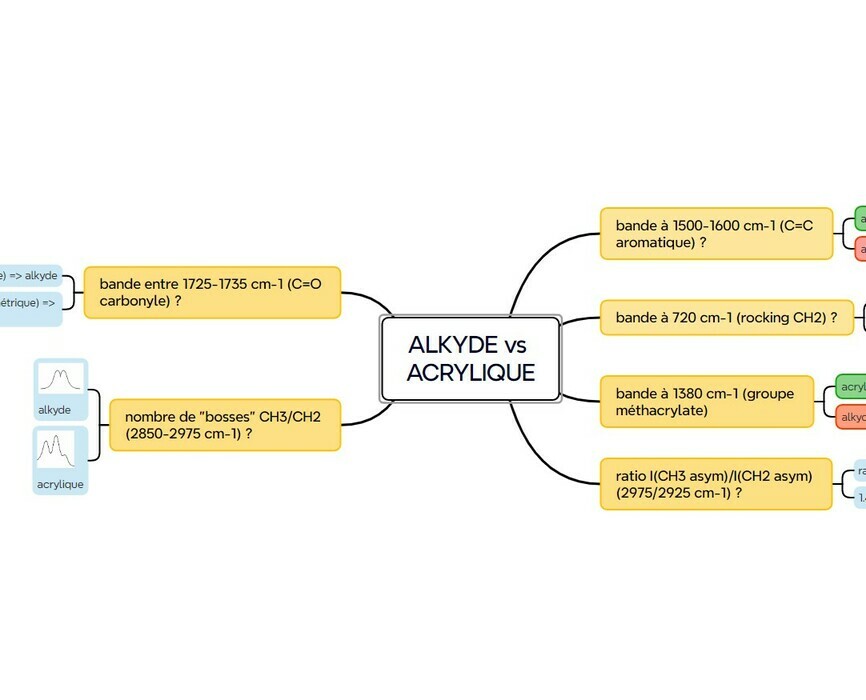
Integrate logical support through Xmind heuristic maps, helping to reinforce or question hypotheses suggested by FTIR scoring.
-
Qualify the method using real and varied FTIR datasets to validate its relevance across multiple operators.
Methodology
Building the spectroscopic database
Each paint type was described using 10 to 15 characteristic IR bands, compiled from scientific literature and OSE SERVICES’ accumulated expertise. For each band, the following data were recorded:
-
Position (cm⁻¹)
-
Theoretical intensity (weak, medium, strong, very strong)
-
Associated chemical function
-
Specific comments (effect of ageing, stability, redundancy, etc.)
This corpus enabled the structuring of a harmonised reference for spectral comparison.
Development of the Python programme
The programme, designed in accessible Python, invites the user to input observed IR bands. It then compares this data against each paint database entry using two approaches:
-
Simple score: number of matching bands over the total expected.
-
Weighted score: accounting for the relative importance of bands (weighting according to intensity).
The programme outputs, for each paint:
-
A simple and weighted percentage of correspondence
-
A list of detected functions
-
A ranking of the most compatible paint types
Decision-support tool with Xmind flowcharts
Complementing the script, Ella created logical maps illustrating key spectral correlations. These maps include:
-
Relative importance of bands (rated 1–5)
-
Presence of shoulders, symmetries, etc.
-
Notes in cases of ambiguity or artefacts
This allows the user to cross-check script results with reasoned decision-making, reducing errors linked to linear interpretation.
Qualification of the methodology
Validation protocol
A set of FTIR spectra was selected, covering a wide range of binders and complex cases (multi-layered samples, aged materials, interferences). The aim was to evaluate:
-
The programme’s ability to propose the correct binder within its top two responses.
-
The user’s ability to identify the correct binder, with or without programme assistance.
Each spectrum was interpreted independently by several operators (experienced FTIR analysts and beginners). Results were compared against reference identifications.
Score analysis
Overall results showed that the programme achieved a success rate above the initial targets. Performance exceeded 80% correct identifications for trained operators.
Key findings included:
-
Strong performance for acrylic, alkyd, and epoxy paints.
-
Ambiguity for oils, suggesting enrichment of oil-specific bands in the database.
-
Cross-checking with Xmind maps proved essential when scores were close.
-
Operator variability was noted, linked to the accuracy of band input and residual quality.
Advantages of the tool
-
Objectivity: results no longer rely solely on human judgement.
-
Time efficiency: quick input and immediate output.
-
Traceability: each result can be justified retrospectively.
-
Reproducibility: different operators achieve more consistent results.
Limitations and avenues for improvement
-
Sensitivity to mineral filler bands may bias results if residuals are not properly processed.
-
Oils are under-represented in the database, requiring enhanced weighting criteria.
-
Future developments could include the interpretation of secondary peaks and shoulders.
From development to routine use at OSE SERVICES
Since validation, the tool has been integrated into OSE SERVICES’ internal analytical protocols. It is now used:
-
As a systematic step prior to drafting FTIR reports.
-
As a training support for new staff.
-
As a comparison tool against extraction hypotheses (acetone tests, colorimetric tests, etc.).
Flowcharts are also used in training and presentations to communicate complex spectroscopic decisions.
Ella’s internship demonstrated that a simple, open-source tool, built on a well-structured database, can significantly enhance the interpretation of FTIR spectra. This project is a concrete example of the synergy between algorithmic approaches and domain expertise in the field of materials conservation.
References
-
Derrick, M. R., Stulik, D., Landry, J. M. (1999). Infrared Spectroscopy in Conservation Science. Getty Conservation Institute.
-
Learner, T. (2004). Analysis of Modern Paints. Getty Conservation Institute.
-
Rivenc, R., et al. (2017). “FTIR Identification of Artists' Materials.” Studies in Conservation, 62(4), 218–232.
-
OSE SERVICES Internal Documentation – Python FTIR Identification Programme
-
Qualification Report – Ella’s Internship Results